
All 33 sessions, about 32.4 hours: the two days, on demand.
Every session of esse-sense Future Forum 2026 was recorded. The archive offers the recordings with subtitles and summaries. One purchase covers all sessions with no viewing deadline; if streaming is ever to end, buyers are notified 30 days in advance. Purchase and viewing are in Japanese.
Purchase and the free report
The overall report of the forum (PDF, in Japanese) is free to download. Session recordings are sold on the Japanese archive page.
Each title below opens a page with the session summary and the speakers' profiles.
Wed 16 Sep 2026
10:00 / Main Hall / 36 min
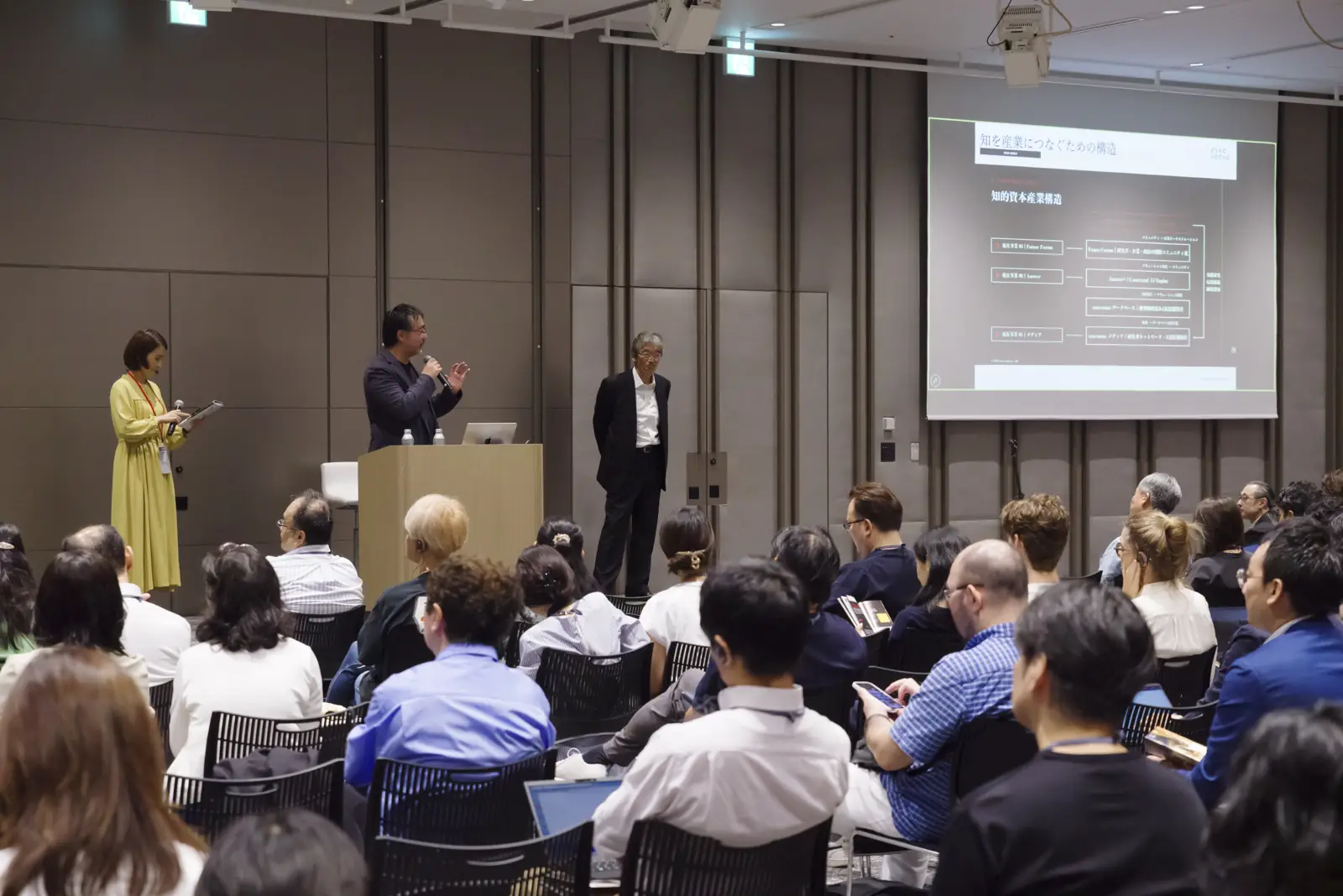
Making the future in the age of AI, and the orchestration of knowledge
Yu Anma, Yuya Nishimura, Eriko Matsuo
The concept of the "orchestration of knowledge," which translates research knowledge into industry, and esse-sense initiatives such as ANSWER+ and the collaboration with Dubai were discussed.
10:30 / Main Hall / 60 min
Industry creation and future strategy — the path and the role of the Dubai Future Forum
Patrick Noack
Through the Dubai Future Foundation's ten years of institution building, the possibility of industry creation combining Japan's accumulated knowledge with Dubai's experimental foundation was discussed.
11:30 / Main Hall / 46 min
An innovation lab that produces serendipity
Keisuke Goda
Against the background of the fragmentation of science and its drawbacks, the session described how foundation support and the interdisciplinary organization Serendipity Lab are advancing the reintegration of fields and the development of Super EVs, an anti-aging engineering technology.
12:10 / Main Hall / 40 min
The industry-creating society called for beyond AI and AGI
Yasuo Nishiyama
The session discussed the barriers in the valley that stands between a research seed and its growth into industry, and the iCube concept, a new platform that combines AI and human judgment.
12:50 / Main Hall / 52 min
Industry creation and the orchestration of knowledge
Patrick Noack, Keisuke Goda, Takayuki Miyagi, Yasuo Nishiyama, Yuya Nishimura
A panel session in which people leading industry creation discussed the gap between research seeds and industrialization, tolerance for failure, the benefits of waste, and the sustained commitment of top leadership.
14:30 / A 4F ROOM 1 / 62 min
Innovation by Serendipity — the lab that designs for the unplanned
Keisuke Goda, Shutaro Takeda, Yuko Sasahara, Makiko Shinoda
The session discussed whether serendipity can be designed not as an individual quality but as a mechanism of relationship building that breaks down disciplinary walls, number of trials, invitation design, and avoidance of optimization.
16:00 / A 4F ROOM 1 / 63 min
Biomanufacturing as a new field
Kazuhiko Kawashita, Lina Sakai, Yuka Tanimoto, Akihiko Kondo
From two settings, fermentation and a biofoundry, the session described the challenges and strengths of Japan's bio-based manufacturing in funding, value proposition, use of AI, and talent.
17:30 / A 4F ROOM 1 / 65 min
Brain tech — where neuroscience meets what lies beyond AI
Mitsuaki Takemi, Tomohiro Ishizu, Genshiro A. Sunagawa, Kan Akutsu, Teruyoshi Sumiya
Researchers from different fields, brain tech, artificial hibernation, and neuroaesthetics, discussed technologies for measuring and stimulating the brain and finding beauty, and how these will merge with AI beyond that.
14:30 / B 4F ROOM 2 / 61 min
Can science and finance be connected?
Yosuke Yasuda, Masaaki Amma, HARUNA Takayuki, Yuichi Katayori
On connecting science and finance, the speakers exchanged views ranging from FDSF's activities and the practice of university-originated VC to the perspective of aesthetic sense.
16:00 / B 4F ROOM 2 / 62 min
The role of leaders who become good ancestors
Ayano Hirose, Shoukei Matsumoto, Hiroki Fujimoto, Teruyoshi Sumiya, Noyuri Mima
Centered on the question of the "good ancestor," the session discussed subtraction, knowing when to step back, frameworks of ethics, how to measure long-term value, leadership for the common good, and liberation from optimization.
17:30 / B 4F ROOM 2 / 65 min
Can universities become the base for startup talent?
Eric Masanobu Matsunaga, Yuya Nishimura, Yuka Tanimoto
A dean at Aoyama Gakuin University discussed the mechanism of entrepreneurship education through an off-campus organization and endowed courses, the division of roles for researchers, education design based on sensory ability, and the walls of university organizations.
14:30 / C 4F Temporary Office / 67 min
From industry-academia collaboration to the orchestration of knowledge — its future
Katsuyuki Sato, Akiko ONO, Hiroyuki Ono, Hideki Kusano, Yuya Nishimura, Takuji Sakamoto
Five practitioners of industry-academia collaboration discussed the shift from one-to-one to N-to-N and who should take on the orchestration of knowledge.
16:00 / C 4F Temporary Office / 61 min
From research grants to systemic change — the future of corporate foundations
Masaaki Uchida, Mariko Kita, Toshiko Fujita, Shion Kubota, Kenta Aoki, Yuya Nishimura
The session discussed whether research grants from corporate foundations can expand into systemic change through age-reversed grants, discretionary funding, community building, and trust-based philanthropy.
17:30 / C 4F Temporary Office / 68 min
From the space business to a space industry — the future of industry creation
Takahiro Nakamura, Yosuke Yasuda, Yuki Tazaki, Shun Sagara, Shinichi Takata
For the two frontier industries of space and the ocean, the session discussed the structure of resistance to entry, namely vested interests, regulation, and technology, and the possibility of collaboration connecting the two as space.
14:30 / E 5F Studio / 62 min
Science for Capital — Where Neuroscience Meets AI (with Zero Institute)
Yuka Tanimoto, Genji Kawakita, Hiroo Miyata, Yasutaka Kameoka
Starting from ZERO INSTITUTE's researcher support model, the session discussed three intersections of neuroscience and AI, measurement technologies, the structure of research funding, laboratory automation, and the evaluation of researchers and their dilemmas.
16:00 / E 5F Studio / 69 min
Science for Capital — longevity and the science of rejuvenation
Itaru Yoshizawa, Eriko Matsuo, Jun Suto, Shuzo Yamamoto
People from VC, advertising, and XPRIZE discussed the undefined nature of the longevity industry, the immaturity of the science, and barriers in funding and talent.
17:30 / E 5F Studio / 60 min
Science for Capital — fusion and industry creation through technology integration
Shutaro Takeda, Yuko Sasahara, Tomohito Oyobe
A conversation in which the founder of a fusion startup discussed researchers' motivation to start businesses, the history of fundraising, the industry's culture of cooperation, policy support, and the reproducibility of university-originated startups.
Thu 17 Sep 2026
10:00 / Main Hall / 28 min
Realising the future through the orchestration of knowledge
Isao Miyama, Yu Anma, Yoichi Takizawa, Yuya Nishimura, Eriko Matsuo
Against the background of AI-based future forecasting becoming management infrastructure and industry walls dissolving, the session discussed the functions that remain on the human side in the AI era: aesthetic sense, leaps of thought, and giving meaning.
10:40 / Main Hall / 38 min
A question from futures anthropology — the myths inside our technologies
Sarah Pink
A lecture that offered a rethinking of futures research that does not rely only on technology-centered foresight, by deeply understanding people's experiences of the future through anthropological methods.
11:40 / Main Hall / 64 min
Beyond the Frame: Causality, Responsibility, and the Creation of a New Future
Christopher Currell
A solo lecture that, drawing on a background in music and VR research, set out a way of thinking that goes beyond frames of reference, seeks causes, and acts with responsibility.
12:40 / Main Hall / 58 min
Leadership that connects the future to industry
Christopher Currell, Sarah Pink, Tatsuo Ogawa, Mutsuo Iwai, Yuya Nishimura
Two executives and a futurist-architect discussed how "frames" work in corporate management and what lies beyond them: embodied knowledge, philosophy, and consensus building.
14:30 / A 4F ROOM 1 / 66 min
Rejuvenation and the new shape of healthcare
Yosuke Tojo, Kengo Suzuki, Jun Suto, Eriko Matsuo
The session discussed the frontier of rejuvenation research, including senescent cell removal, brain delivery, and biological age measurement, and the issues of industrialization and mental health shown by XPRIZE Healthspan and Shiseido Beauty Park.
16:00 / A 4F ROOM 1 / 70 min
AI for Science — the foundation of knowledge that AI makes possible
Shuji Kitahara, Kouta Minamizawa, Masaki Suwa, Eriko Matsuo
In the field of AI for Science, the session discussed where to draw the line between judgments that can be entrusted to AI and those that cannot, covering grant review, where responsibility lies, support for materials discovery, and the acquisition of embodied knowledge.
17:30 / A 4F ROOM 1 / 64 min
How informal encounters make a city creative
Haruka Ono, Mitsuhiro Yamazaki, Miki Iida, Tetsuji Kuroda, Teruyoshi Sumiya, Kyosuke Sakakura
The session discussed informal self-governance, relationships, and design outside urban planning, from both examples of urban areas in Africa and community practices in Japan.
14:30 / B 4F ROOM 2 / 63 min
Embodied knowing and sensibility
Yuki Inoue, Ryusuke Naka, Nobuyoshi Ohmuro, DAIKOKU Tatsuya, Yuko Nakanishi
While questioning the very existence of embodied knowledge, the dialogue ranged from individual bodily sensation to the intelligence of a place, collective unity, mathematical structure, and activity in the AI era.
16:00 / B 4F ROOM 2 / 57 min
The aesthetics of economy — picturing a good economy
Yosuke Yasuda, Emi Onozuka, Tomohiro Ishizu, Yohei Azakami, Mami Yoda
From the perspectives of neuroaesthetics, economics, philosophy, and practice, the session discussed how the connection between beauty and goodness supports a good economy.
17:30 / B 4F ROOM 2 / 64 min
The future of people and AI
Susumu Namikawa, Yuya Nishimura, Yuka Tanimoto
A session that reframed AI from a "tool" to a "companion" and discussed a vision of a future where people and AI coexist, centered on intrinsic motivation, changes in power structures, and a shift in the axes of economic value.
14:30 / C 4F Temporary Office / 65 min
Crossing Borders: Points of Departure
Hideo Miura, Akishige Hokugo, Satoru Moriaki, Naohiko Kohtake, Masahiro Fujikawa
Centered on the PI Map, which makes Japanese researchers living overseas visible, the session discussed building trust, support for hosting, and connection to national strategy.
16:00 / C 4F Temporary Office / 64 min
Crossing Borders: Methods
Akishige Hokugo, Ichiro Yuki, Dai Saito, Kenji Togasaki, Naohiko Kohtake
Techniques for building relationships in overseas partnerships, and the problem of Japanese companies' decision-making structures hindering overseas expansion, were discussed with real examples.
17:30 / C 4F Temporary Office / 62 min
Crossing Borders: Outcomes
Hideo Miura, Naoto Mizuguchi, Keiichiro Nishi, Yuki Nishida
Four practitioners discussed support systems, contract forms, the distinction between R and D, and differences in KPIs for turning collaboration with overseas academia into actual business results.
14:30 / E 5F Studio / 57 min
Science for Capital — robotics that merges with the body
Kouta Minamizawa, Akihiko Nagata, Teruyoshi Sumiya
The session discussed the current state of research on connecting and extending the body with robots and AI, the branching of value into substitution, complement, and extension, and barriers to social implementation.
16:00 / E 5F Studio / 59 min
Science for Capital — what brain machine interfaces open up beyond AI
Soichi Tajima, Kan Akutsu, Teruyoshi Sumiya
The state of the art and practical examples of BMI/BCI, Japan's position, rights over brain data, and the future relationship between humans and AI were discussed.
17:30 / E 5F Studio / 62 min
Science for Capital — the future of physical AI in harmony with people
Katsuya Hashizume, Masaki Suwa
A session that discussed the relational capital between people and machines created by physical AI through embodied knowledge, the yokai metaphor, boundary design, and the concept of a spinal-reflex AI.